

Food additives - risks and benefits

Sylvia Thompson examines the world of food additives - what they are, how they're regulated in the EU, and why they remain a concern for consumers.
If you do all your food shopping around the edges of the supermarket, you will mainly fill up your trolley with wholefoods – fruit and vegetables (both fresh and frozen), freshly baked breads, fresh cuts of meat, fresh fish, cheeses, milk and yogurt. And while some of these foods – bread, cheese, milk and yogurt in particular – will have undergone processes to extend their shelf life and the addition of sugars and flavour enhancers, they more or less maintain their status as wholefoods.
But if you stray into the middle aisles which are full of food packed in cans, jars, cardboard cartons and plastic containers, you are entering the domain of foods that have undergone more processing, and which will often have higher amounts of food additives including preservatives.
Food has been preserved for millennia, and we are all familiar with natural preserving methods using salt, vinegar, smoke or alcohol to give us out-of-season access to foods which would otherwise have gone stale. But in the last 50 years or so, a plethora of both naturally occurring and chemically synthesised additives have been put into various processed foods to enhance texture, flavour, colour or appearance alongside preservatives to extend their shelf life.
With recent attention on the health impacts of ultra-processed foods (loosely defined as hyper-palatable, heavily marketed cheap foods with poor nutritional content), food additives have come under new scrutiny. But before we take a deep dive into understanding the different types of food additives and how their safety is monitored in the EU, let us first briefly look at how this recent focus on ultra-processed foods has also cast a spotlight on food additives.
Ultra-processed foods
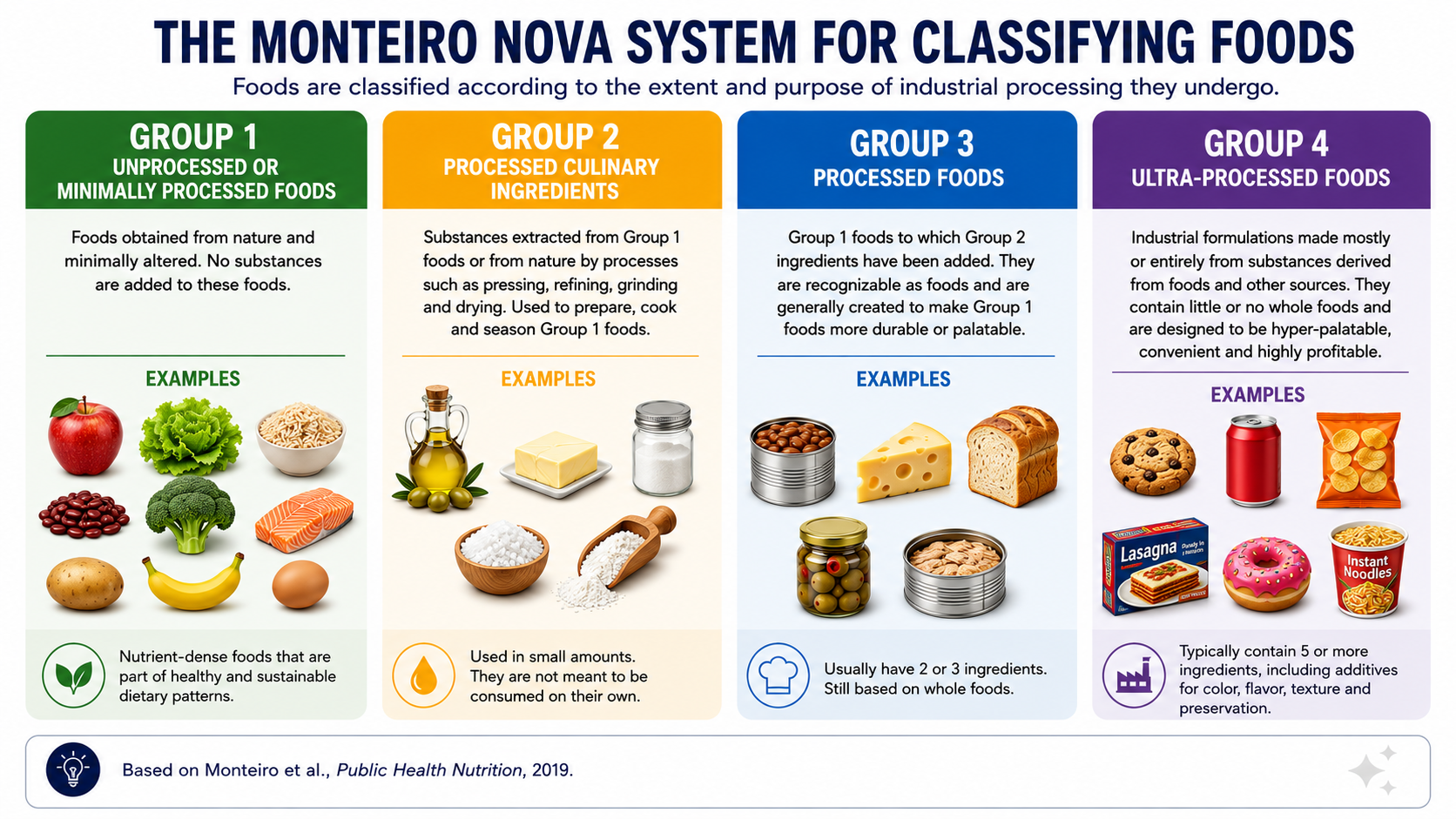
The term 'ultra-processed foods' was first introduced by Carlos Monteiro, Professor of Public Health Nutrition at the University of São Paulo in Brazil. He developed a new food classification system called Nova which measures food according to how processed it is rather than its nutritional content.
In the Nova system, group one foods are unprocessed or minimally processed (vegetables, meat, dried fruit), group two are processed culinary ingredients (butter, salt, sugar, flour), group three are processed foods (tinned foods, cured meats, cheeses – i.e. foods that have been preserved, pickled, fermented or salted). Group four foods, Monteiro defines as ultra-processed foods (e.g. mass-produced hamburgers, ice-cream, biscuits, breakfast cereals) made from sugars, oils and starches which have been transformed through the use of colours, flavourings, emulsifiers and other additives to make them more palatable. The standout feature of this fourth category is that these foods contain ingredients that you would not usually find in a domestic kitchen.
Because they are often heavily marketed and cheap, some health professionals are concerned that these ultra-processed foods are displacing wholefoods and leading to nutritionally poor diets for those who overconsume them. But, as yet, no regulations have been introduced to limit their use.
The EU approach to food additives
Now let's return to food additives to examine how their safety is monitored. But firstly, what exactly is a food additive?
In the European Union, food additives are defined in legislation (EC Regulation 1333/2008, Article 3) as "any substance not normally consumed as a food in itself and not normally used as a characteristic ingredient of food whether or not it has nutritive value, the intentional addition of which to food for a technological purpose in the manufacture, processing, preparation, treatment, packaging, transport or storage of such food results, or may be reasonably expected to result, in it or its by-products becoming directly or indirectly a component of such foods".
And while this is a comprehensive definition to account for all the different stages of food processing and distribution, essentially, it includes additives such as colours, preservatives, antioxidants, thickeners and stabilisers, flavour enhancers and flour treatment agents. Salt and sugar – as standard food ingredients in all kitchens – are not food additives. And vitamins and minerals added to fortify foods such as breakfast cereals are governed under different EC regulations.
How E-numbers work
The reason for including a food additive in a certain food is divided into 27 functional categories of food defined under EU legislation. But to complicate matters further, the same additive may be put into one food for one reason and added to a different food for another reason. For example, ascorbic acid (a synthetic form of Vitamin C with the food additive code of E300) can be an antioxidant or a flour treatment agent, depending on its use in a food. As an antioxidant, ascorbic acid prolongs the shelf life of the food by preventing the oxidation process, while as a flour treatment agent it improves the texture and volume of commercial breads and rolls.
Food additives are regulated in the European Union following the scientific assessment of their safety by the European Food and Safety Authority (EFSA). An acceptable daily intake (ADI) is established for each substance and only additives that remain below this level under realistic consumption conditions are approved for use. In Ireland, the Food Safety Authority of Ireland (FSAI) must ensure that all food consumed, produced, distributed or marketed here complies with these legal requirements.
Food additives must be safe when used. There must be a technological need for their use – for example, to maintain or improve the safety, freshness, taste, texture or appearance of food. Their use must not mislead the consumer and must be of benefit to the consumer.
FSAI spokesperson
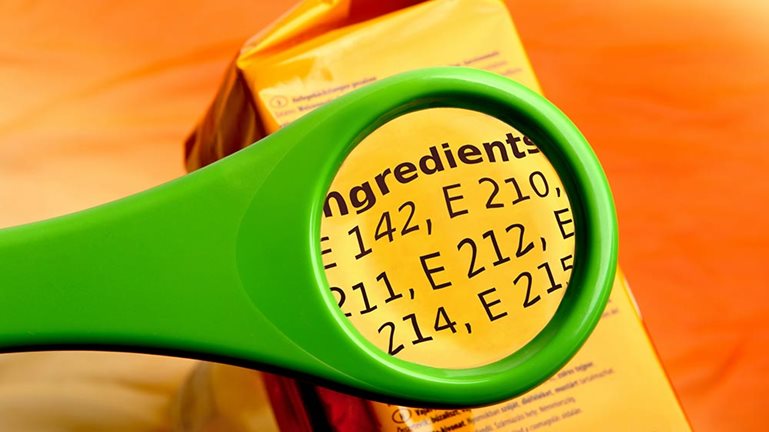
The use of food additives is harmonised across the EU and in Northern Ireland, and all approved additives are given an E number to include on the label which is identifiable across different languages. The FSAI states that a food having an E number isn't a danger sign. E numbers have been used for years in order to communicate simply across the range of languages in the EU and to help consumers make informed choices. The FSAI advises that the presence of an E number should be regarded in a positive, rather than a negative light.
E numbers – from E100 to E1499 – define food additives by their function. So, for example, E100s are used for colour additives, those with E200s are preservatives, those with E300s are antioxidant/acidity regulators. Emulsifiers/thickeners will have E400 numbers and flavour enhancers are given numbers in the E600s. You can see the full list of all E numbers authorised in the EU together with the English name of each additive, both in numerical and alphabetical order at www.fsai.ie.
Food additives can be banned
It's important to note that certain food additives can be removed from the EU authorised list of food additives following re-evaluation. The amount allowed in foods can also be reduced or a cautionary note added with regard to excessive consumption of foods or drinks that contain certain food additives. For example, following a public campaign against the white food colouring additive, titanium dioxide (E171), this food additive was banned in the EU and Northern Ireland in 2022. Used in a wide range of bakery products, soups, sauces, salads, sandwich spreads, processed nuts, chewing gum, food supplements and cake icing, E171 was considered to cause potential damage to the genetic material in cells (i.e. genotoxicity).
Another example is how ascorbic acid (E300) replaced potassium bromate as a flour improver in bread when the latter was banned in the EU in 1990. Studies found a link between potassium bromate and kidney and thyroid cancers in rodents. However, bromated flour still appears on labels of dozens of baked goods for sale in the United States. The US Food and Drug Administration hasn't banned it, but the state of California became the first state to ban its manufacture, sale and distribution with a new law taking effect in 2027.
Nitrites and nitrates in processed meat
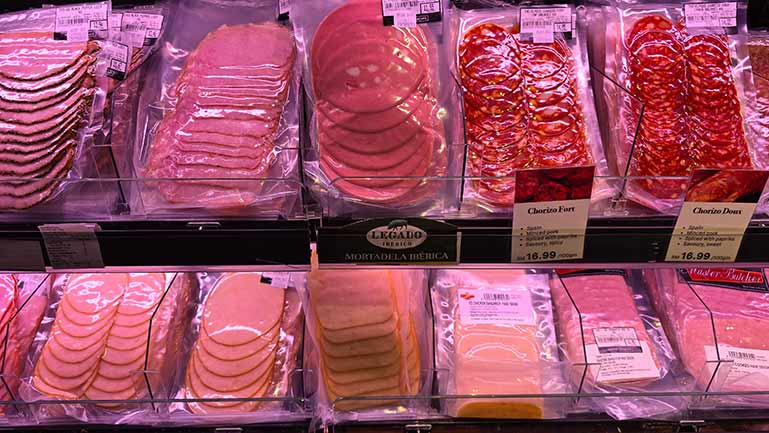
The addition of nitrites and nitrates (E249–E252) to processed meats has also become somewhat controversial. Nitrites and nitrates occur naturally in vegetables such as spinach, lettuce, celery and beetroot without causing any harm. They are added to processed meats such as bacon, ham and corned beef to give them a red colour and, more importantly, to reduce harmful bacteria such as Clostridium botulinum which causes life-threatening botulism. Several studies linked high consumption of processed meats to an increased risk of bowel (colorectal) cancer due to the production of carcinogenic chemicals produced during preservation methods (curing/smoking) or cooking methods (high-temperature frying or grilling).
Following re-evaluation of E249–E252 by the EFSA in 2017, the agency advised that these additives – often labelled as sodium and potassium salts of nitrites – were safe when added at permitted levels of 3.7mg of nitrate per kg body weight per day and 0.07mg of nitrite per kg of body weight per day. However, a 50g serving of processed meat such as sausage or ham contains between 1–3mg of nitrite so two servings could push consumption over the ADI. Some innovative bacon producers have replaced nitrites with fruit and spice extracts for customers keen to avoid them.
Azo dyes and children's behaviour

Concerns have also been raised about the use of synthetic colourants called azo dyes. These include E102 tartrazine (yellow), E104 quinoline yellow, E110 sunset yellow FCF, E122 azorubine/carmoisine red, E124 ponceau 4R and E129 allura red AC – all of which continued to be allowed in the EU but with an obligatory warning. The addition of this warning followed an EFSA review of a 2007 Southampton University study which suggested that a mixture of some of these azo dyes together with E211 sodium benzoate (a preservative commonly used in fizzy drinks and sweets, ice cream and sauces) was linked to increased hyperactivity in children.
Products containing these food additives should carry the warning: "may have an adverse effect on activity and attention in children."
EFSA, following review of the 2007 Southampton University study
Some manufacturers have already taken action to remove these artificial colourants from their products. Some experts now advise consumers to choose products with dyes which originate from fruit, vegetables and spices, especially food consumed by children. These include E162 beetroot juice, E160c paprika extract (also known as capsanthin or capsorubin) or E100 turmeric (also known as curcumin).
Are food additives properly regulated?
Food additives remain a top concern for consumers, according to research carried out by Safefood. In its 2024 Safetrak report, Safefood found that additives, E-numbers, dyes and preservatives were the third most important food safety issue for consumers on the island of Ireland.
The international consumer lobby group Foodwatch International is also concerned that EFSA falls short in its evaluation criteria on several grounds. Foodwatch International takes issue with the fact that EFSA carries out its scientific evaluation of food additives primarily based on safety data provided by the food companies themselves. Then the European Commission bases its decision to authorise each food additive and define its ADI on the scientific opinion of EFSA. It is also critical of a delay in a re-evaluation programme for additives approved before 2009 which was due for completion in 2020. By February 2026, 71 food additives of a total 315 still hadn't been re-evaluated.
The assessment process of food additives is too dependent on industry data. Long-term cumulative effects are underestimated, as is the cocktail effect resulting from exposure to multiple additives.
Foodwatch International
Foodwatch International is also concerned that standard regulatory tests requested by authorities only cover possible toxicities, and that endocrine disrupting effects on the microbiota are not taken into account appropriately. The organisation is calling for strict enforcement of clear labelling of E numbers alongside the names of food additives on packaging. Currently, packaging can include either the name of the food additive or the E number.